On this page
A specified expansion joint brand can be replaced only through the applicable project review process. An alternative offer needs permission to be considered, evidence against the actual requirements, disclosure of deviations and documented acceptance by the authorized reviewer. Matching pipe size, flange drilling or a pressure label does not establish equivalence.
This guide focuses on flanged rubber expansion joints in water, cooling and industrial piping. It helps purchasers prepare an alternative technical submittal, meaning the documents supplied for review. It does not declare any two brands interchangeable or establish procurement rules for every country.
1. Confirm Whether an Alternative May Be Submitted
Read the enquiry, equipment specification, approved manufacturer list and relevant purchase conditions together. A named brand may identify the required original product, a reference design, or an item for which alternatives may be considered. These situations require different responses.
If the wording is unclear, ask the purchaser to confirm the permitted route in writing before preparing a detailed substitution offer. Identify who can authorize a departure from the specification. A request for a lower price is not, by itself, permission to supply a different manufacturer.
If the project accepts only the specified original item and no change is authorized, state that the proposed alternative cannot meet that purchasing condition. Do not describe another manufacturer’s product as the original.
2. Define What the Alternative Must Demonstrate
Use the specified item and project duty as the reference, supported by the current drawing and data sheet. Compare the wetted rubber, cover, reinforcement, flange arrangement, installed length, service conditions, movement combinations and restraint requirements. Identify the exact proposed model and construction.
Evidence must apply to the offered size and operating conditions. A rubber family name does not establish chemical suitability, and separate catalogue maxima do not confirm simultaneous movement capability. Product-specific assessment remains necessary.
The Fluid Sealing Association’s Technical Handbook for Expansion Joints in Piping, Edition 8.1 explicitly advises users to confirm the manufacturer’s performance data because products may vary. Its guidance is not a certificate of equivalence for an alternative offer.
For the detailed commercial comparison after the technical basis is defined, use our rubber expansion joint quotation review checklist.
3. Submit Evidence and Disclose Every Deviation
Prepare a requirement-by-requirement response rather than a general statement that the product is “equivalent.” Reference the supporting document and its revision. Separate confirmed compliance, proposed deviations and information still awaiting clarification.
| Review question | Evidence to submit | Required decision |
|---|---|---|
| Is an alternative permitted? | Enquiry clause or written clarification | Confirm the submission route |
| Does the offered construction meet the duty? | Identified model data and material suitability response | Accept, reject or request clarification |
| Will it fit and function in the installation? | Dimensioned drawing, movement confirmation and restraint details | Review interfaces and load arrangement |
| Are required approvals and records applicable? | Documents identifying product, scope and validity | Verify against project requirements |
| Are there unresolved differences? | Explicit deviation list and proposed disposition | Obtain a recorded decision |
For example, if the specification requires one rubber material and another is proposed, label it as a substitution. Provide the suitability basis and request a decision. Do not silently replace the material description in the offer.
A manufacturer’s quality-management certificate does not by itself establish product approval for a particular application. Likewise, an original manufacturer’s test results or certifications cannot be presented as evidence belonging to the alternative product.
4. Keep the Offer on Hold Until Acceptance Is Recorded
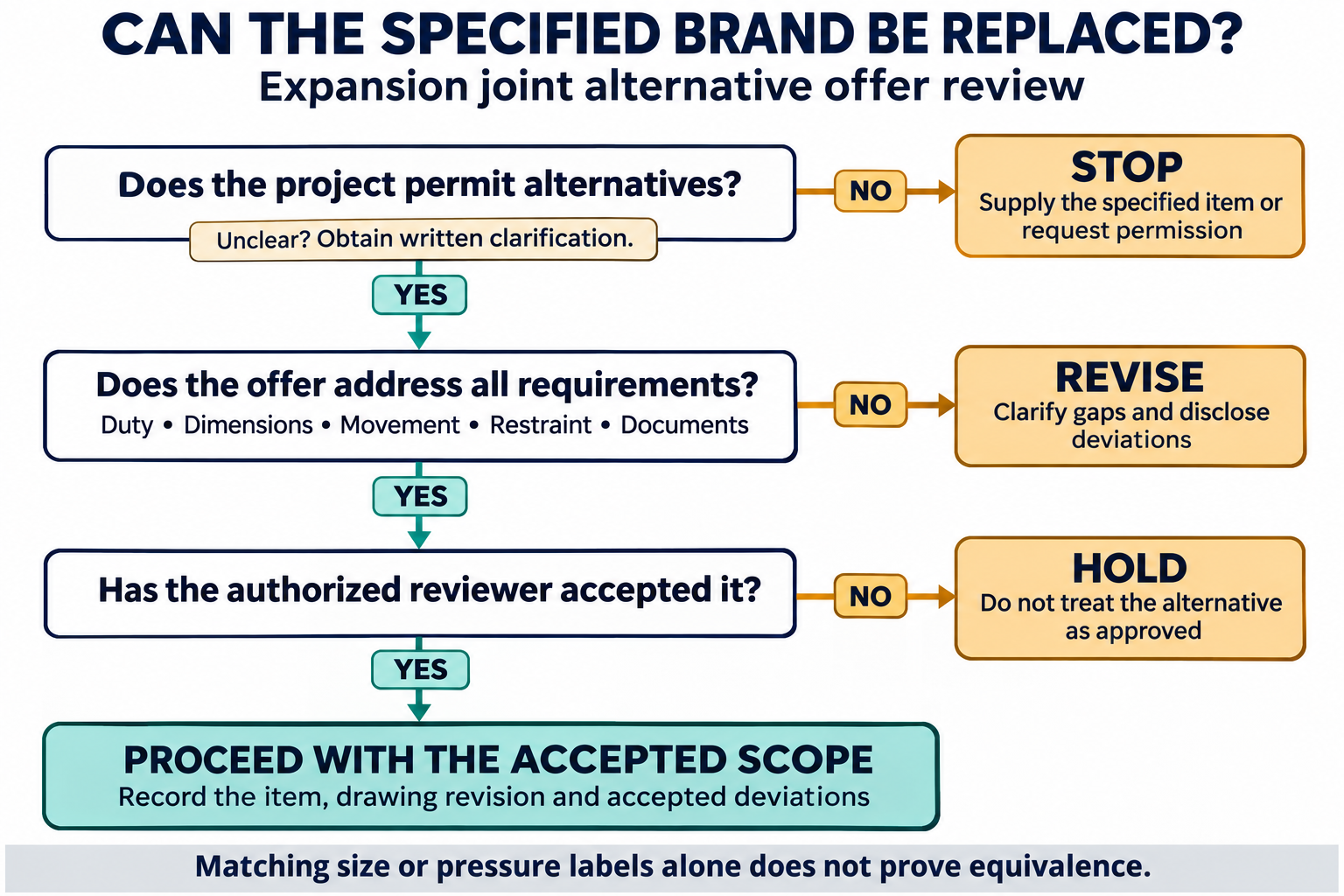
The flowchart above separates permission to submit from acceptance of the proposed scope. A complete submission enables review; it does not make the supplier the approving authority.
Record the reviewer’s decision against the exact model, drawing revision and accepted deviations. A commercial acknowledgement or a request for delivery information should not be interpreted as technical acceptance unless the project process makes that status clear.
Before supply, ensure that the purchase order reflects the accepted alternative and document requirements. Resolve conflicting descriptions rather than assuming the latest email overrides the specification. If acceptance is refused, withdraw or revise the alternative instead of supplying it under the specified brand name.
For a Mingchao rubber expansion joint enquiry, provide the specified item reference, project requirements, available drawings and the permitted alternative-review route. These inputs establish what must be assessed; they are not a promise that an equivalent can be offered.
Mingchao Fluid Technology
https://www.mingchaoft.com/