On this page
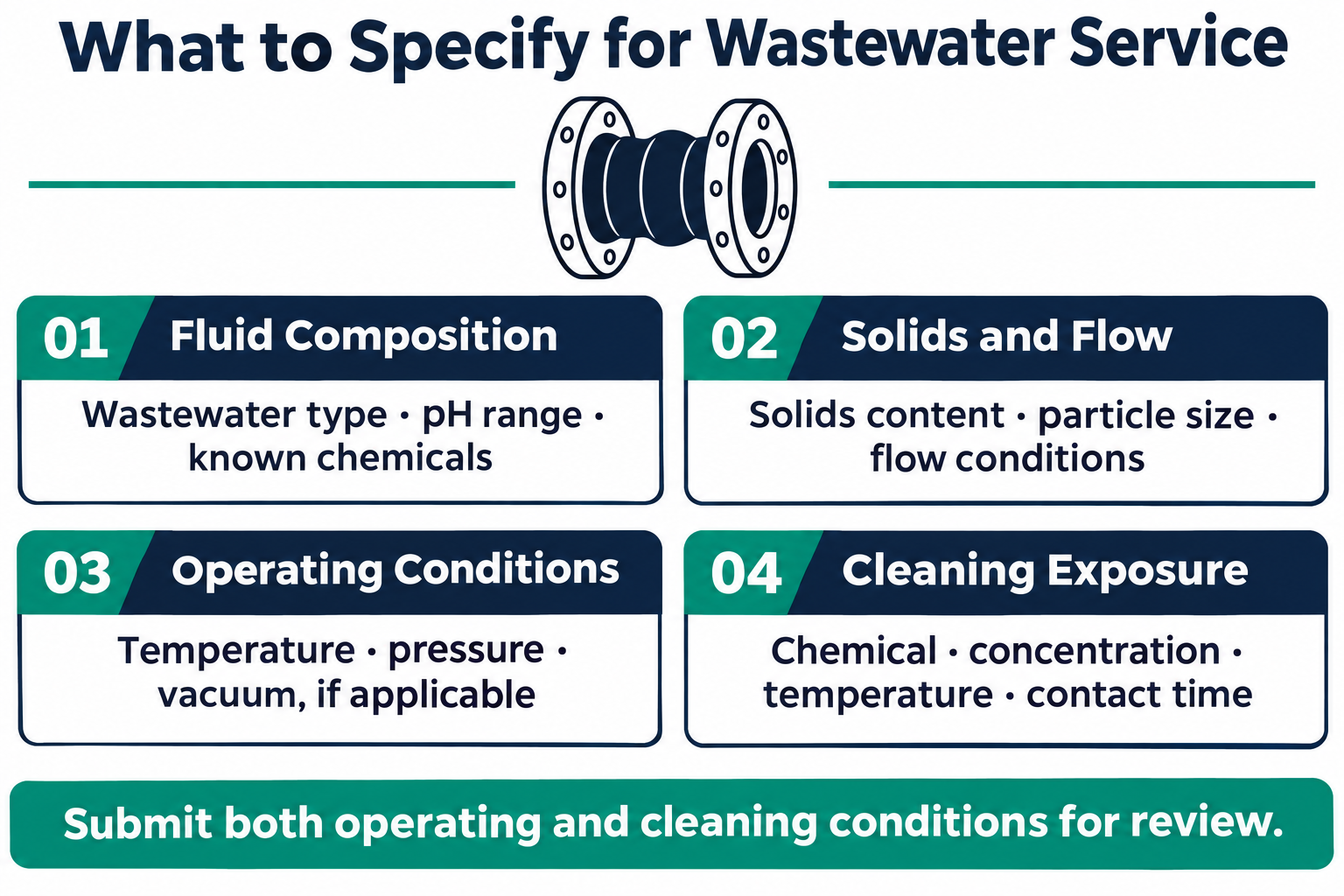
Before selecting a rubber expansion joint for wastewater service, give the supplier four sets of data: the liquid composition, the solids and flow conditions, the operating pressure and temperature, and the cleaning exposure. Ask for written confirmation for the offered model and its wetted rubber, meaning the inner material in contact with the fluid. The word “wastewater” alone leaves these selection inputs open.
This checklist is for water and wastewater engineers, contractors and procurement teams preparing an enquiry or technical submission. Use a separate record for each line or service if its duty changes through the plant.
1. Identify the Wastewater Stream
Start with the line tag and its location in the treatment process. Municipal influent, treated effluent, pumped sludge and industrial discharge can contain different liquids and solids. A description such as “pump discharge from the sludge transfer line” gives the supplier a better starting point than the plant name.
Provide known constituents and their concentration ranges, the expected pH range and any intermittent chemical discharge. Attach a recent analysis or chemical safety data sheet where available. If the drawing only says “wastewater,” ask the process team what enters that line during normal operation and whether the composition changes during batch discharge or plant cleaning.
Use resistance charts to screen candidate materials. Ask the supplier to confirm the exact compound against the actual mixture and temperature. A pH range describes acidity or alkalinity but does not identify all the chemicals present. Trelleborg expansion joint chemical resistance reference.
2. Describe Solids, Flow and Operating Limits
Record the type of solids, approximate concentration and largest expected particle size. Describe whether the stream carries grit, fibrous matter or thick sludge. If the information is available, include the flow range and note whether solids settle when the pump stops. These details let the supplier evaluate potential wear or accumulation around the offered joint’s internal profile.
Report the temperature range and minimum and maximum pressure at the joint. Identify whether the values are gauge or absolute. Include credible transient or vacuum conditions where the piping designer identifies them. Ask the supplier to check the complete joint construction for those conditions and the required movement. Fluid Sealing Association piping expansion joint handbook.
3. Record Cleaning as a Separate Exposure
For each flushing, cleaning or disinfection step, state whether the joint stays in the line. If it does, list the chemical name, concentration at the joint, temperature, contact time and frequency. Attach the cleaning procedure if it defines how the chemical is mixed or whether a rinse follows.
For example, if a line normally carries treated effluent but is periodically disinfected, give the supplier both exposure cases. Request separate confirmation of the proposed wetted compound for the effluent and for the disinfectant at its working concentration and temperature. Flag unknown cleaning conditions as open items before approval.
4. Submit a Service Data Sheet Before Approval
Copy this table into the enquiry and ask the supplier to respond against the model and drawing revision offered.
| Review item | Data to provide | Supplier confirmation |
|---|---|---|
| Liquid | Line tag, stream source, constituents, concentrations and pH | Wetted compound and compatibility basis |
| Solids and flow | Solids type, content, particle size and flow conditions | Internal profile and any wear or buildup concerns |
| Operation | Temperature, pressure range, vacuum and movement if applicable | Model limits for the stated conditions |
| Cleaning | Chemical, concentration, temperature, duration and frequency | Compatibility for each exposure and any restrictions |
Attach the installation drawing and note the flange details and installed length. List any missing inputs and ask who will resolve each one. If you are comparing quotations, request the same response format from every supplier. Rubber expansion joint quotation checklist.
For a Mingchao enquiry, send the completed service data sheet and drawing with your required submittal documents. Mingchao Rubber Expansion Joints.
Mingchao Fluid Technology
https://www.mingchaoft.com/