On this page
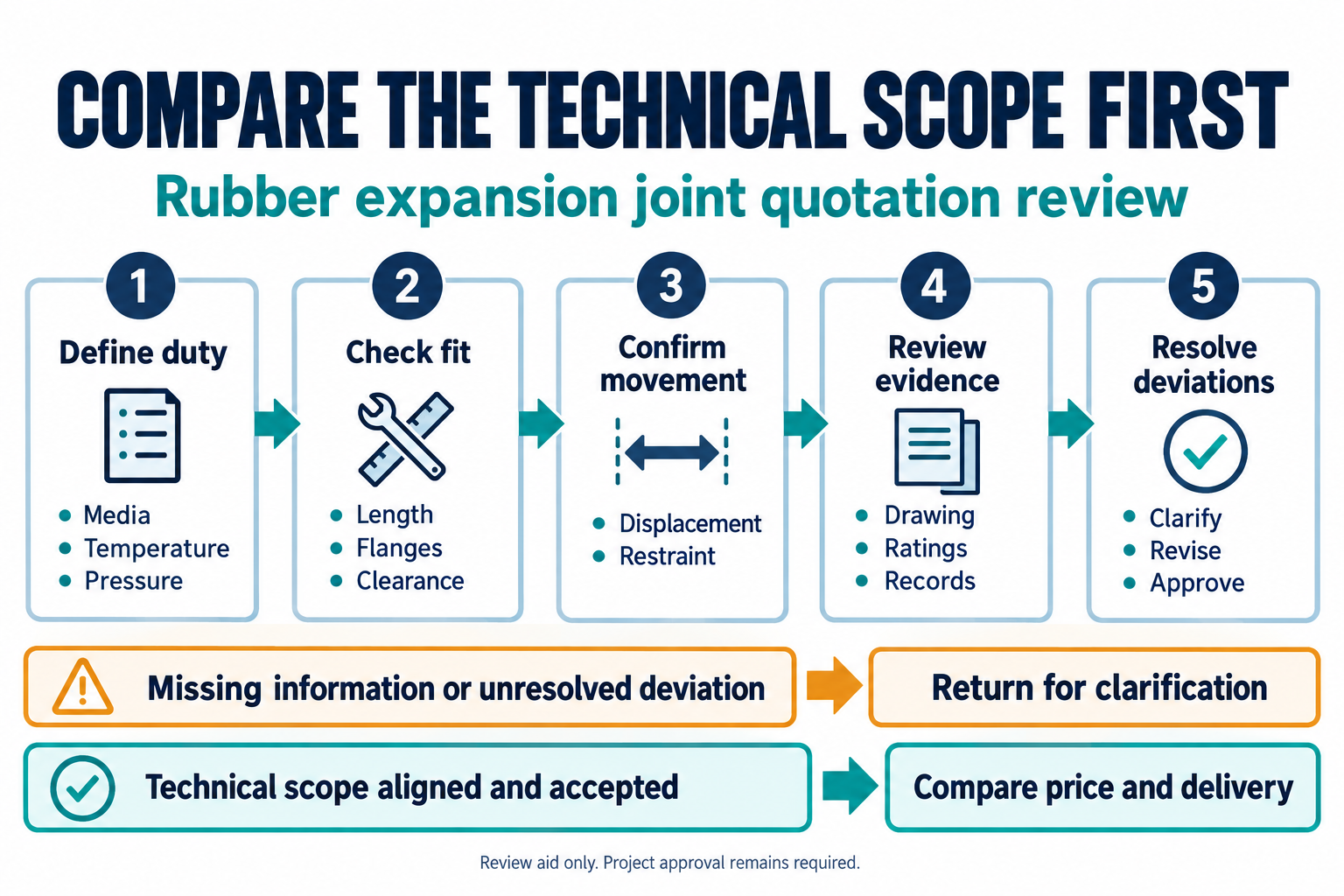
Rubber expansion joint quotations are comparable only when they cover the same service conditions, installed dimensions, movement requirements, restraint arrangement and delivery documents. Matching nominal diameter and a pressure label is not enough. Before comparing prices, record what each supplier offers, identify missing information and resolve technical deviations with the responsible project reviewer.
This checklist is for engineers and purchasers reviewing flanged rubber expansion joints for water, cooling and industrial piping. It supports bid review; it does not replace system design or product-specific approval.
1. Give Every Supplier the Same Operating Conditions
Start with one enquiry sheet and an identified specification revision. State the fluid, concentration where relevant, solids, cleaning chemicals and operating temperature range. Include the maximum conditions expected at the joint, rather than describing the duty only as “water service.”
Distinguish normal operating pressure, design pressure, surge conditions and the proposed system test conditions. State any vacuum requirement and whether pressure values are gauge or absolute. A pressure rating must apply to the offered size, construction and temperature. A flange pressure designation alone does not establish the allowable pressure of the complete rubber joint.
The Fluid Sealing Association’s Technical Handbook for Expansion Joints in Piping, Edition 8.1, Appendix L provides a useful specification-sheet reference. This article’s comparison format is an editorial review aid, not an FSA approval form.
2. Compare the Offered Construction and Installed Fit
Ask suppliers to identify the rubber tube in contact with the fluid, the outer cover, reinforcement and metal components. A description such as “EPDM joint” does not establish the complete construction or its suitability for a particular chemical mixture. Any proposed material substitution needs a stated basis and project acceptance.
Compare the face-to-face length, bore, flange drilling standard, sealing-face arrangement and installation clearances against a dimensioned drawing. For international enquiries, write the actual flange standard and designation rather than only “standard flange.” Do not assume that PN, Class and JIS designations are interchangeable.
For replacement work, use the existing rubber expansion joint replacement checklist to collect site measurements. Bid review then checks whether the quoted item meets those recorded requirements.
3. Review Movement and Restraint Together
List required axial, lateral and angular displacement, the installation offset, and which movements occur together. Separate catalogue maxima do not demonstrate that the joint can accept their combination. Request confirmation for the proposed installed condition.
Clarify whether control units, tie rods, retaining rings or other hardware are included, and what each component is intended to do. Hardware that limits travel should not automatically be treated as a substitute for the system’s pressure-thrust restraint. The piping designer must confirm the intended load path and movement arrangement.
A cheaper offer that excludes required hardware is a different scope. Record that difference before making a price comparison.
4. Use One Comparison Table for Every Offer
The review flowchart shows the sequence. Use the table below to capture the result for each supplier; add an evidence reference and reviewer decision to every row.
| Review item | Project requirement | Supplier offer | Deviation or missing information | Evidence / decision |
|---|---|---|---|---|
| Service conditions | Fluid, temperature, pressure, vacuum and test conditions | Record offered duty | Identify exclusions | Applicable data sheet / pending |
| Materials | Wetted tube, cover, reinforcement and metals | Record construction | Identify substitutions | Material statement / pending |
| Installed fit | Length, bore, flange details and clearances | Record dimensions | Identify mismatches | Drawing and revision / pending |
| Movement and restraint | Displacement, combinations and load arrangement | Record confirmed capability and hardware | Identify unconfirmed conditions | Manufacturer response / pending |
| Inspection and documents | Agreed tests, acceptance criteria and records | Record included scope | Identify omissions | Inspection plan / pending |
“Pending” means unresolved. A blank cell should not be interpreted as compliance.
5. Close Deviations Before Purchase
Agree which drawings, material statements, inspection reports and identification records must accompany delivery. Specify test conditions and acceptance criteria where required. A pressure-test report demonstrates the reported test result; it does not establish chemical compatibility, fatigue life or suitability for every operating condition.
Once the technical scope is accepted, compare price, quantities, lead time, packing and delivery terms on the same commercial basis. Carry accepted deviations and drawing revisions into the purchase order so the delivered item can be checked against the agreed offer.
For a technical enquiry, provide the completed requirement sheet and installation drawing with the selected rubber expansion joint reference. This gives the supplier a defined basis for identifying missing information before quotation.
Mingchao Fluid Technology
https://www.mingchaoft.com/