On this page
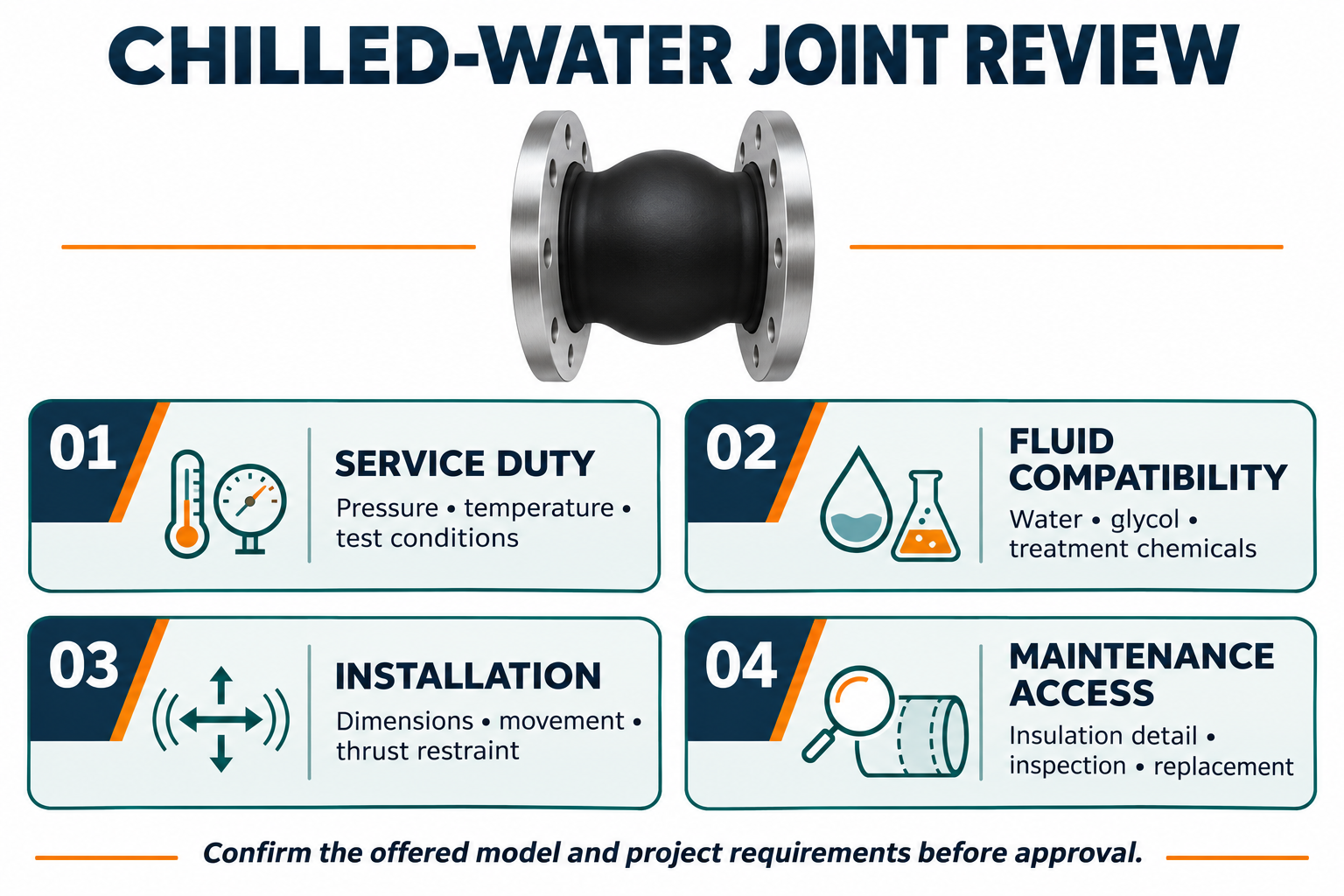
Before approving a rubber expansion joint for a chilled-water system, verify the offered model against the actual fluid, pressure-temperature duty, test conditions, movement and installation arrangement. The submission must also explain how insulation and maintenance access will be handled. A pipe size, pressure designation or statement that the joint is “for HVAC” is not enough to establish suitability.
This checklist is for engineers, MEP contractors and purchasers reviewing building or district-cooling connections, including projects in the Middle East and Southeast Asia. It addresses flanged rubber joints, not every flexible connector or a universal local approval procedure.
1. Separate Operating Duty from Test Conditions
List the normal and maximum fluid temperatures, operating pressure, design conditions and any minimum-pressure or vacuum condition. Identify where the joint sits in the system. A connection near a pump or at a different elevation may face conditions that cannot be read from the chiller’s nominal rating alone.
Ask for the offered model’s allowable pressure at the relevant temperature. Do not treat the flange drilling designation as proof of the complete assembly’s pressure capability. Outdoor ambient temperature is a separate exposure condition; it does not replace the fluid temperature in the selection data.
State the proposed hydrostatic test pressure, temperature and duration separately. Have the manufacturer confirm the joint and restraint arrangement for that test before testing. A product test record does not automatically approve the site test procedure. Do not apply an assumed multiplier to a catalogue pressure without checking the applicable project requirements and product limits.
2. Identify the Water Treatment and Rubber Construction
“Chilled water” describes the service, but not the complete chemical exposure. Record whether the loop contains water only, ethylene glycol or propylene glycol, and give the concentration and temperature. Include corrosion inhibitors, biocides, flushing chemicals and cleaning conditions where applicable.
Request a compatibility response for the proposed wetted rubber and the actual mixture. A generic EPDM or neoprene label is not a substitute for confirmation of the offered construction. Temporary flushing or cleaning can introduce different conditions from normal operation; explain whether the joint will remain installed during those activities.
The Fluid Sealing Association’s piping expansion joint handbook advises users to confirm manufacturer-specific performance data. Its general guidance does not certify a particular Mingchao model or chemical mixture.
3. Review the Installation and Pressure-Thrust Arrangement
Check installed face-to-face length, mating flange dimensions and sealing faces against the drawing. Define initial offset and the movements expected together during operation. A flexible joint should not be used to pull poorly aligned piping into position.
Confirm pipe support, anchors and any control or tie-rod arrangement with the responsible piping designer and joint manufacturer. Pressure thrust is the force generated by internal pressure acting over the joint’s effective area. The joint’s flexibility does not remove that force or make it a pipe support.
Rod settings can affect available axial travel. Review them against the required movement, rather than treating rods as an optional accessory with no functional consequence. Our pressure-thrust and restraint guide explains this distinction.
4. Resolve Insulation and Maintenance Before Approval
Cold surfaces may require condensation control, but the insulation detail must preserve joint movement and access for inspection and bolt work. Obtain a product-specific detail that addresses removability, vapor sealing and the clearance needed around the flexible body.
Mercer Rubber’s installation guidance calls for cold-line insulation to allow removal for retightening. This illustrates the access issue; use the offered manufacturer’s instructions for the final detail. Do not copy a hot-service insulation rule or bury the joint in a rigid covering.
Use the following table to close the submission, meaning the document package sent for technical review.
| Review item | Information required | Acceptance basis |
|---|---|---|
| Service and test duty | Pressure, temperature, test procedure | Model-specific limits and confirmation |
| Fluid exposure | Glycol, additives, cleaning conditions | Documented material compatibility |
| Installation | Drawing, combined movement, restraint | Reviewed dimensions and load arrangement |
| Maintenance | Insulation detail and access space | Manufacturer instructions and project acceptance |
For a Mingchao rubber expansion joint review, send the service data, fluid composition, installation drawing and required documents. Identify unresolved items before approval; do not turn missing information into an assumed compliance statement.
Mingchao Fluid Technology
https://www.mingchaoft.com/