On this page
Can a rubber expansion joint absorb water hammer? Its flexibility alone does not establish that it can control a hydraulic transient or withstand every phase of one. A joint may be suitable within a system whose transient loads have been evaluated, but it should not be specified as the remedy for an unresolved water hammer problem.
For a proposed joint, the useful starting point is the pressure history at the joint location—not only the pump discharge pressure, a system-wide maximum, or a steady operating rating. The review must also account for the resulting pipe movement and loads on the joint, restraints and connected equipment.
Start with the event at the joint
Rapid changes in liquid velocity can create pressure waves that travel and reflect through a piping system. Pump trips, starts, valve operations and check-valve closure are possible initiating events. Their effect at a particular rubber expansion joint depends on the complete system and the sequence of events.
A transient analysis should identify the relevant operating cases and report pressure against time at the proposed joint location. The first positive peak is only part of that history. Later reflections may produce another peak or a period of substantially lower pressure.
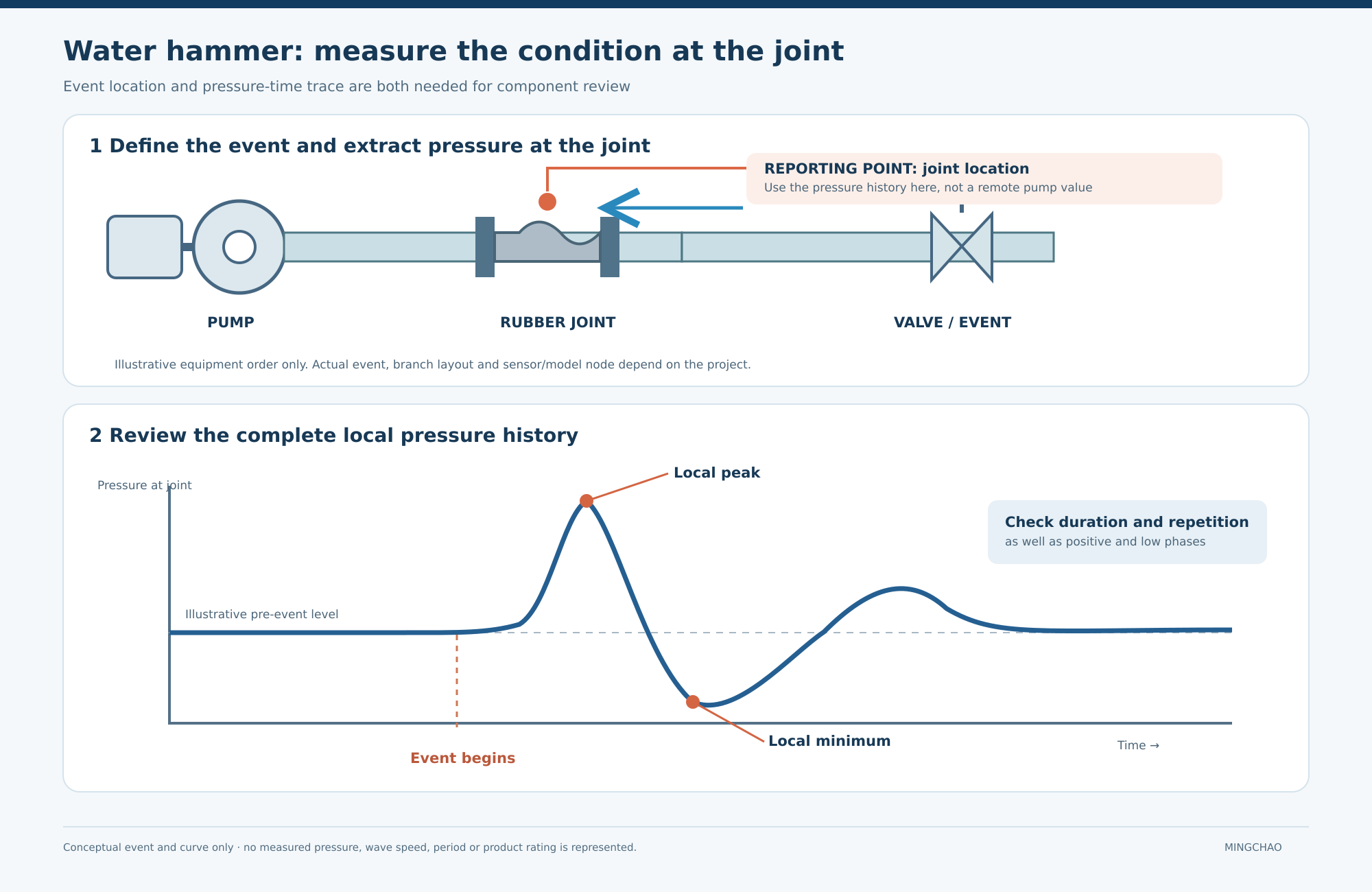
Conceptual illustration of a joint location and a possible local pressure history. The curve is not a measured or calculated result and has no numerical pressure scale.
The diagram above explains why a single maximum pressure cannot describe the whole duty. Before assessing a product, the reviewer needs the local maximum and minimum pressures, their timing, and the operating cases that produce them.
Check the high and low phases separately
At the high-pressure phase, confirm the proposed joint’s allowable pressure for the stated conditions. The reviewer also needs to assess pressure thrust, the restraint arrangement and loads transmitted to adjacent pipework or pump nozzles. A published steady working-pressure rating, by itself, is not approval for an unspecified transient event.
At the low-pressure phase, establish the minimum absolute pressure and clearly state whether any other values are reported as gauge or absolute pressure. If the event places the joint under vacuum, its vacuum suitability must be checked for the actual installed length, size and support arrangement. A low calculated pressure does not, on its own, prove that column separation occurred; that conclusion requires an appropriate hydraulic assessment.
Frequency matters too. An occasional pump trip and a routinely repeated operating sequence should not be treated as the same duty without review. Record the relevant event frequency and duration rather than describing both simply as “water hammer.”
For a separate discussion of low-pressure duty, see Rubber Expansion Joints in Vacuum Service: Minimum Pressure, Installed Length and Support Requirements.
Pressure history is not a movement calculation
The pressure trace does not, by itself, give the axial, lateral or angular displacement imposed on the joint. Pipe supports, anchors, guides, tie rods, pump connections and the stiffness of the surrounding system determine how forces and movement are distributed.
For each relevant event, the piping designer should establish the joint’s installed position and the movement it may experience. Where structural analysis is needed, its loads and displacements must be assessed alongside the hydraulic results. Do not combine separate maximum values as though they occurred at the same instant unless the analyses support that combination; do not ignore a governing combined case either.
The distinction is explained further in Pressure Thrust and Axial Movement in Rubber Expansion Joints: The Role of Tie Rods and Anchors and Combined Movement in Rubber Expansion Joints: Installation Offset and Operating Displacement.
What should be submitted for a joint review?
A manufacturer cannot confirm transient suitability from the phrase “water hammer service.” The following handover gives each party a defined question to answer.
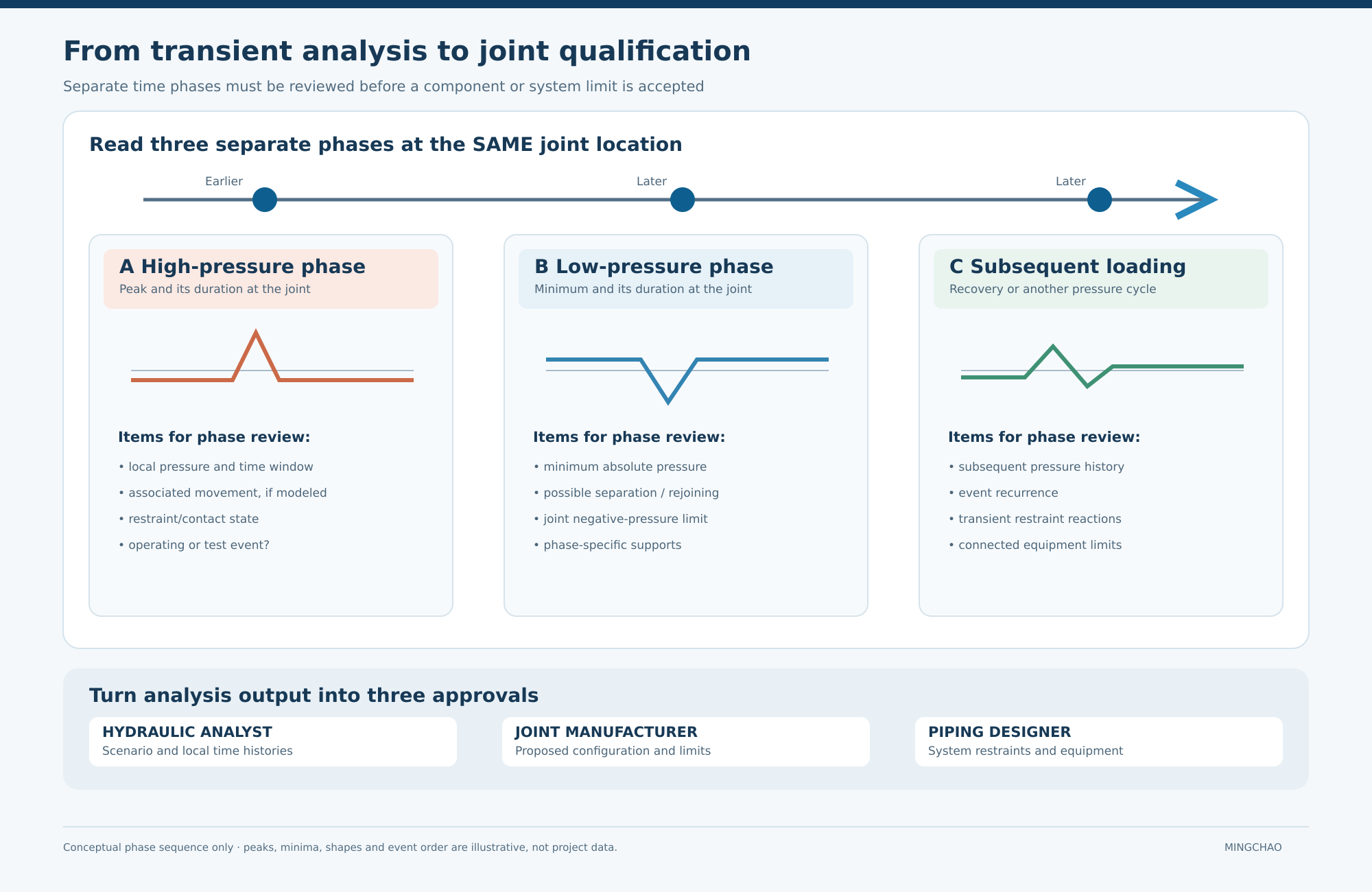
Conceptual sequence of loading phases and review responsibilities. The diagram does not show a product performance envelope or project-specific calculation.
The diagram above separates the event into phases so that a favorable result for one phase is not mistaken for approval of the entire event.
| Review item | Information or decision required |
|---|---|
| Hydraulic analyst | Identify the operating cases; provide pressure-versus-time results at the joint, including maximum and minimum absolute pressure, event duration and recurrence. State the model assumptions and whether further assessment of low-pressure effects is needed. |
| Piping designer | Confirm the joint location and installed length; assess concurrent displacement, anchors, guides, restraints and loads on connected equipment for the governing cases. |
| Joint manufacturer | Review the proposed size, construction, materials and configuration against the submitted pressure, temperature, vacuum, movement and restraint conditions. State the limits of any project-specific confirmation. |
The reviewer should also provide the service fluid, normal operating pressure and temperature, connection details and any relevant installation restrictions. Missing information should be identified explicitly rather than replaced with an assumed value.
Address the transient in the system design
If the analysis identifies unacceptable pressure or movement, the piping and hydraulic engineers must evaluate changes that address the initiating event and the system response. Depending on the modeled case, that work may involve pump operation, valve behavior, restraint design or a suitable surge-control measure. No particular device should be prescribed solely because a joint is present near the pump.
A rubber expansion joint can then be evaluated for its intended duties under the resulting, defined conditions. It should not be asked to compensate for unknown surge pressure, unsupported pressure thrust or unverified pipe movement. For pump-specific installation considerations, see Rubber Expansion Joints for Pump Suction and Discharge: Selection Requirements.
For a project review, provide the local transient results, piping arrangement and operating conditions together. Mingchao Fluid Technology’s technical information and project requirements page lists information that can accompany a product enquiry.