On this page
- 1. Agree the Evidence Before Manufacture
- 2. Match the Records to the Actual Assembly
- 3. Read Material and Welding Records Separately
- 4. Check What the Test Actually Demonstrated
- 5. Use a Requirement-to-Evidence Acceptance Record
- Preparing a Mingchao Metal Hose Enquiry
- Technical References and Related Resources
A metal hose assembly should be accepted against the purchase specification and approved drawing, supported by records that apply to the delivered item. A pressure-test certificate alone does not establish material conformity, weld quality, movement capability or service life.
This guide covers document review and inspection before installation of a braided corrugated metal hose assembly. It is not a test procedure. The agreed specification and approved inspection plan determine the required checks.
1. Agree the Evidence Before Manufacture
An instruction such as “supply a tested stainless steel hose” leaves too much open. Before placing the order, agree:
- The assembly configuration, service conditions and applicable specification or standard edition.
- Required inspections, tests and acceptance criteria.
- Material and welding documents to be supplied.
- Product identification and record traceability.
- Any purchaser or third-party witness points.
If ISO 10380 is specified, identify the applicable edition and requirements. Naming a standard on a quotation is not evidence that the delivered assembly meets it.
Agree special documentation early. Some evidence, including material traceability and witnessed manufacturing stages, may be difficult or impossible to reconstruct after production.
2. Match the Records to the Actual Assembly
Begin with the order item, approved drawing revision and assembly identification. Depending on the agreed system, identification may use a tag, serial number or batch reference. A batch record must show which delivered assemblies it covers.
Check the hose size, overall length and measurement datum, end connections, flange drilling and any specified orientation. Record deviations rather than forcing the hose into position.
Review the braid and accessible end-connection regions for handling damage, broken wires, crushing, distortion or contamination. These observations help identify discrepancies; visual inspection cannot rule out hidden defects.
The records must describe the delivered configuration, not simply another hose of the same nominal diameter.
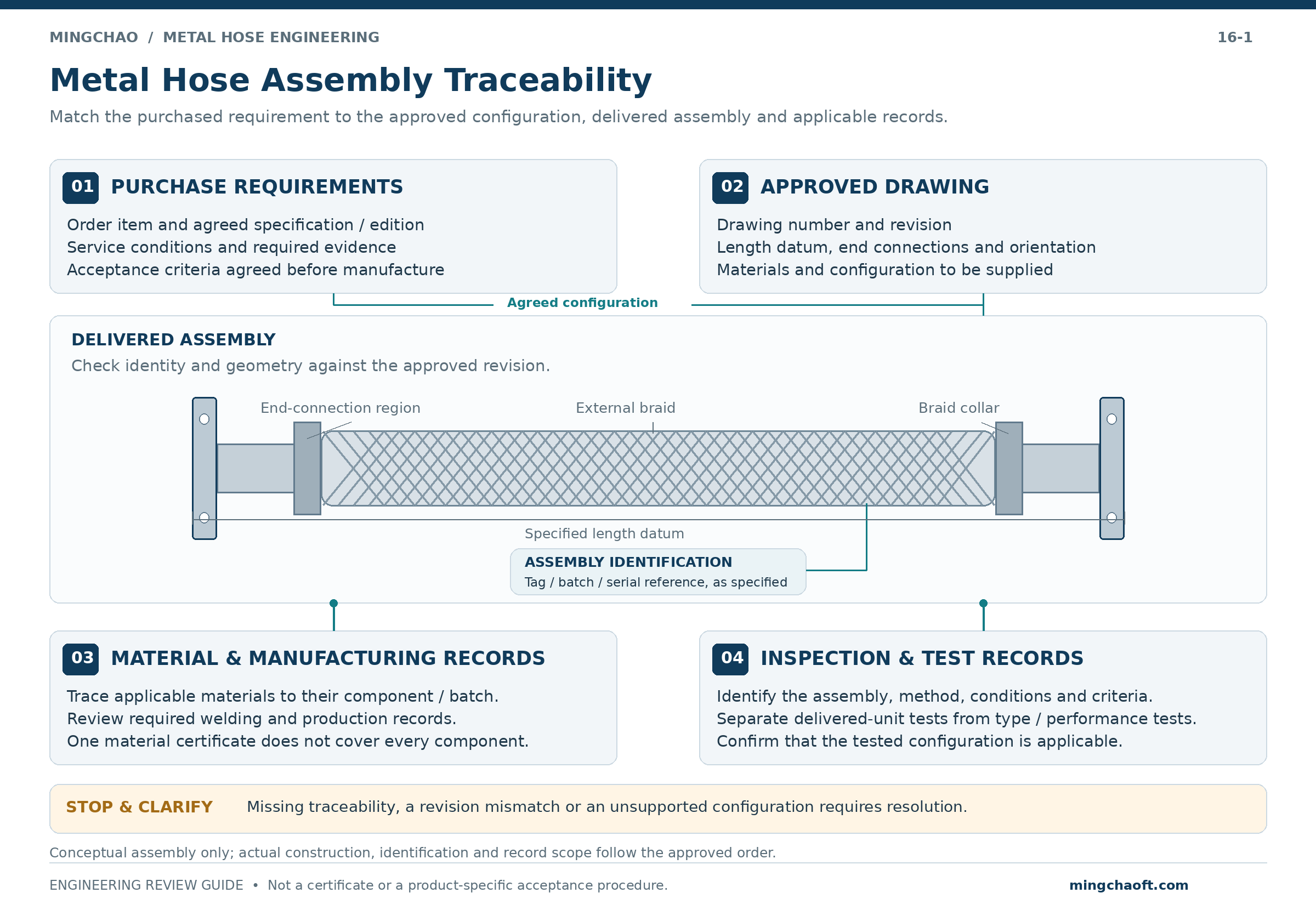
The illustration above links purchase requirements, the approved drawing, assembly identification and applicable records. Material traceability must identify the components or batches actually covered.
3. Read Material and Welding Records Separately
“Stainless steel” does not identify the grade of every component. The corrugated tube, braid, collars and fittings may have different specified materials.
A material certificate supports the identity and reported properties of the material it covers. Check its connection to the relevant component or batch. One certificate should not be assumed to cover the entire assembly.
Welding documents answer another question. Where required, review the applicable welding procedure, procedure qualification, welder or operator qualification, and production records. Confirm that their scope covers the actual joint and manufacturing process.
Qualification documents do not establish that every production weld is defect-free. Any required weld inspection must also have its own applicable results. Nondestructive examination means checking a component without destroying it; the chosen method and examined areas determine what it can reveal. ARCFLEX HOSE & BELLOWS LIMITED
4. Check What the Test Actually Demonstrated
For metal hose leak testing, the method matters. A bubble test and a helium leak test have different detection capabilities. A result is meaningful only with the stated method, sensitivity or detection criterion, conditions and acceptance limit. Penflex
A hydrostatic pressure test uses liquid to pressurize the assembly under a defined procedure. Depending on that procedure, it may also include a leak check. Do not assume that a pressure-test result demonstrates the leak sensitivity required for another service.
For each hose assembly test record, check:
- Assembly or covered batch identification and procedure reference.
- Test medium, pressure and pressure basis, temperature, and hold time as applicable.
- Method, examination coverage and required instrument identification or calibration evidence.
- Acceptance criteria, recorded result, date and responsible personnel.
Use the agreed procedure for test values. Do not select a generic pressure multiplier or hold time from an unrelated product.
A successful pressure test does not, by itself, establish the allowable working pressure at temperature, repeated-flexing life or equipment end loads. Type or performance tests may address additional properties, but their tested configuration and applicability must be checked separately.
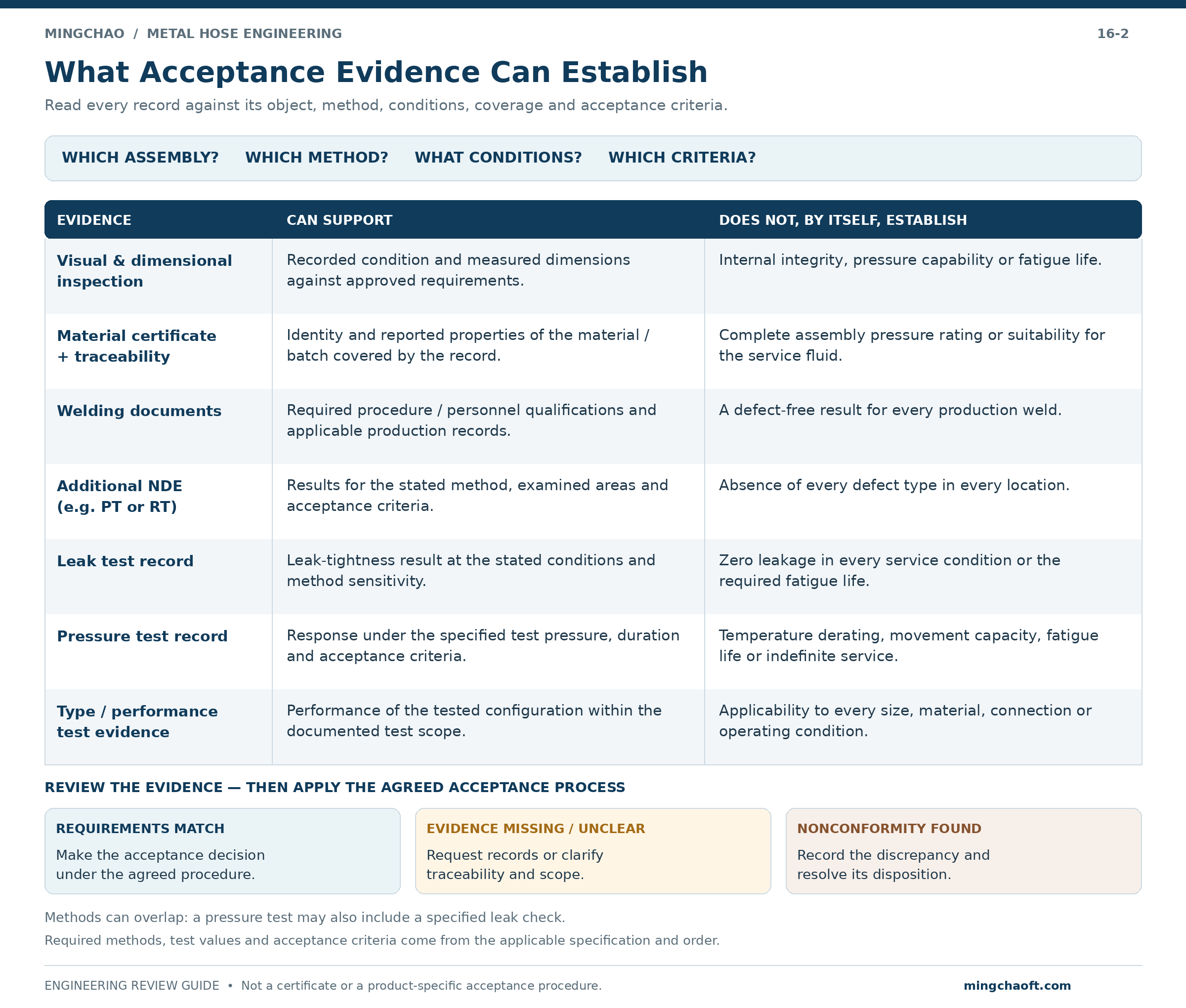
The illustration above separates the evidence provided by each record. Methods can overlap, but no single test automatically covers every purchase requirement.
5. Use a Requirement-to-Evidence Acceptance Record
Use one line per requirement. The following is a review structure, not a universal mandatory document list.
| Requirement | Evidence to Review | Essential Check |
|---|---|---|
| Correct assembly | Order, approved drawing and product identification | Same item and applicable revision |
| Correct dimensions | Measured results against the drawing | Defined datum and tolerances |
| Specified materials | Required material certificates and traceability | Correct components and batches |
| Welding requirements | Applicable qualifications and production records | Correct process and scope |
| Leak or pressure test | Required procedure and completed test record | Correct item, conditions and criteria |
| Special performance | Applicable design or performance evidence | Coverage of the supplied configuration |
Add the actual document reference, review result, discrepancy, responsible person and closure status. Avoid ticking “certificate received” when its coverage has not been checked.
For example, a pressure report naming a different assembly cannot close the test requirement until the supplier establishes the correct traceability. This is an evidence gap; it does not alone prove that the hose has physically failed.
Where evidence is missing, request clarification. Where the product or result does not meet requirements, record the nonconformity and obtain the agreed disposition before release. Technical concessions should be approved by the responsible parties, not decided informally at installation.
Preparing a Mingchao Metal Hose Enquiry
For a JR Stainless Steel Flexible Metal Hose, provide the drawing, size, length, medium, pressure, temperature, movement and end connections. Include the required inspection and documentation package so its availability and scope can be confirmed before order acceptance.
Keep procurement acceptance and application approval connected: receiving the correct, tested assembly does not replace checking its installed geometry or operating conditions.
Technical References and Related Resources
- JR Technical Datasheet — PDF
- Metal Hose Pressure Ratings: Temperature, Braid and End-Connection Limits
- Technical Information & Project Requirements
- Penflex — Nondestructive Testing Program
- Arcflex — Testing & Inspection
External references explain inspection methods; they do not establish Mingchao manufacturing capability, certification or project compliance.
Henan Mingchao Fluid Technology Co., Ltd.
www.mingchaoft.com