On this page
- 1. Identify the Assembly Behind the Pressure Rating
- 2. Record Pressure and Temperature as Paired Conditions
- 3. Apply Temperature Derating to the Correct Configuration
- 4. Check the Braid, End Fittings and Attachment Details Together
- Braid configuration
- End connections
- Attachment details
- 5. Separate Working Pressure, Test Pressure and Burst Pressure
- 6. Compare Quotations on the Same Basis
- Pressure Approval Does Not Complete the Selection
- Technical References and Related Resources
A metal hose pressure rating is meaningful only when it applies to the specified assembly and service conditions. A room-temperature hose rating, a flange designation and a pressure-test certificate answer different questions. None should be used alone to approve a complete hose assembly.
For a stainless steel braided metal hose, the review must cover the corrugated tube, braid, end fittings and attachment details at the required temperature. Pressure capability must also be considered alongside movement, pressure cycling and installation geometry.
This guide explains what to check before accepting a pressure rating or comparing supplier quotations.
1. Identify the Assembly Behind the Pressure Rating
Start with the configuration. Two hoses with the same nominal diameter and overall length may have different pressure capabilities.
The rating should be traceable to:
- Hose size, corrugated-tube construction and material.
- Braid material and specified braid configuration.
- End-fitting type, material and connection specification.
- Braid termination and fitting-attachment details.
- Assembly drawing or other controlled configuration reference.
The corrugated tube contains the fluid and provides flexibility. The external braid helps restrain pressure-induced elongation. Braid collars and attachment joints connect these elements to the end fittings. Their design and manufacture affect the performance of the assembled product. hosemaster.com
A rating for the hose-and-braid combination does not, by itself, establish the rating of the finished assembly.
A product-family pressure range is useful for initial selection, but it does not establish that every diameter, braid option and end connection achieves the highest published value.
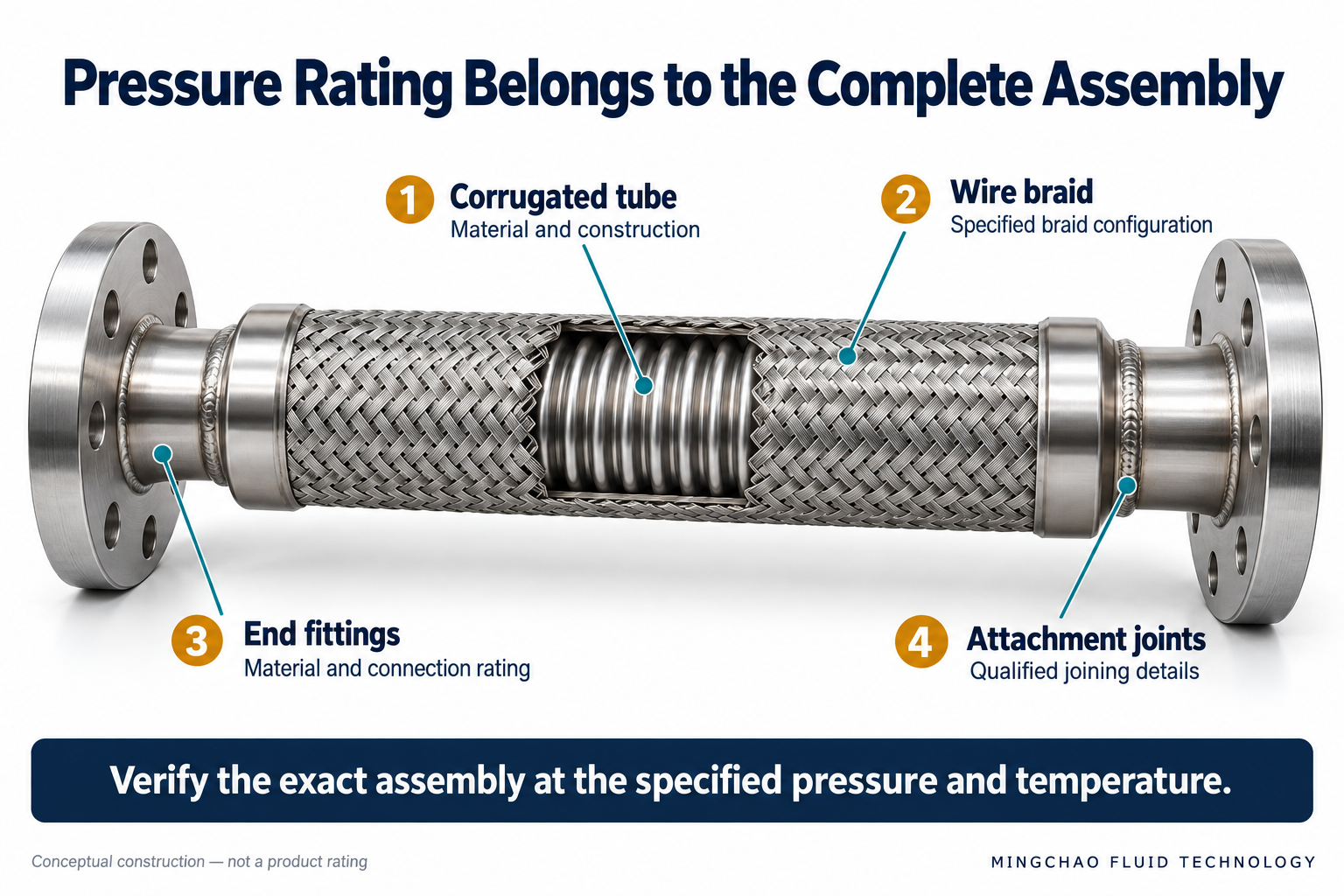
The illustration above identifies the main areas requiring review. It shows a conceptual assembly, not a manufacturing drawing or a pressure rating for a particular product.
2. Record Pressure and Temperature as Paired Conditions
Avoid specifying only “maximum pressure” and “maximum temperature” without explaining whether they occur together.
Prepare a service-condition schedule:
| Condition | Pressure information | Corresponding temperature | Additional information |
|---|---|---|---|
| Normal operation | Operating pressure or range | Temperature during normal operation | Continuous or intermittent service |
| Start-up and shutdown | Expected pressure changes | Temperature during those changes | Frequency and duration |
| Governing design condition | Required design pressure | Specified design temperature | Applicable project design basis |
| Transient event | Peak pressure at the hose location | Temperature during the event | Duration, repetition and analysis basis |
| Minimum-pressure condition | Minimum internal absolute pressure | Corresponding temperature | External pressure or vacuum requirement |
State the units and whether pressure is gauge or absolute. Where external pressure is relevant, identify the pressure on both sides of the hose.
The governing condition may be a combination of pressure and temperature rather than the highest pressure alone. A lower pressure at a higher temperature may require a separate rating check.
If project specifications require the maximum pressure and maximum temperature to be considered simultaneously, retain that requirement. Do not substitute a less demanding combination without engineering approval.
3. Apply Temperature Derating to the Correct Configuration
An elevated-temperature working-pressure rating may be obtained by applying a manufacturer’s specified temperature factor to a reference rating. That method is valid only within the scope of the manufacturer’s instructions.
Before applying a factor, establish:
- What reference temperature and pressure rating it uses.
- Which hose, braid materials and product constructions it covers.
- Whether it applies to the hose-and-braid combination or the complete assembly.
- How fittings and attachment methods are assessed.
- Whether the result already includes the required temperature adjustment.
Hose Master’s published guidance, for example, applies a temperature factor to its catalogue working pressure and separately notes that fittings, materials and attachment methods may affect the assembly rating at elevated temperature. Its factors should not automatically be transferred to another manufacturer’s product. Hose Master
Do not apply the same temperature reduction twice. If a supplier has already confirmed the assembly’s allowable pressure at the specified temperature, request that basis rather than reducing the confirmed value again.
Low-temperature service also requires explicit material and assembly suitability; an elevated-temperature derating table does not establish low-temperature approval.
4. Check the Braid, End Fittings and Attachment Details Together
Braid configuration
“Single braid” and “double braid” describe part of the construction. They are not complete pressure specifications.
Braid performance depends on more than layer count. Wire size, braid arrangement, material, fit and termination influence how the reinforcement works with the corrugated tube. Adding another layer is therefore not a universal rule for doubling working pressure. hosemaster.com
Request the rating for the proposed braid configuration and hose size.
End connections
Check the actual fitting specification and its applicable pressure–temperature basis. Confirm the material, connection type and any relevant wall thickness, thread, flange or sealing requirements.
A flange designation identifies the connection specification; it does not establish the pressure capability of the corrugated hose or its attachment joints.
Attachment details
The drawing should identify how the corrugated tube, braid and fittings are joined. The supplier should confirm the applicable joining procedures, inspection requirements and rating basis.
The complete assembly cannot be approved above a governing component or connection limit. However, simply taking the lowest number from unrelated component catalogues is insufficient: the values must apply to compatible conditions, and the assembled construction must itself be supported.
5. Separate Working Pressure, Test Pressure and Burst Pressure
These terms should remain distinct in specifications and quotations.
| Term | What it describes | What it does not establish by itself |
|---|---|---|
| Working-pressure rating | Permitted operating pressure under stated conditions | Suitability at every temperature, movement or pressure-cycle condition |
| Pressure-test result | Performance of the tested item under a defined procedure | Continuous operation at the test pressure or a specified fatigue life |
| Burst-pressure result or rating | Destructive-test performance or a defined burst-rating basis | An allowable operating pressure without an applicable design basis |
A test report should identify the assembly or batch, procedure, medium, pressure, temperature, duration and acceptance criteria.
Do not derive an operating rating by dividing a reported burst pressure by an assumed safety factor. Likewise, do not treat a short pressure test as evidence that a hose will withstand repeated flexing or pressure pulsation throughout its intended service life. Pressure shock and pulsation require additional consideration beyond a steady-pressure value. Hose Master
Where ISO 10380 is specified, agree the applicable edition and required evidence. The standard covers minimum requirements for design, manufacture, testing and installation; merely naming it in a quotation does not demonstrate that a particular assembly meets those requirements. Corrugated metal hoses and hose assemblies
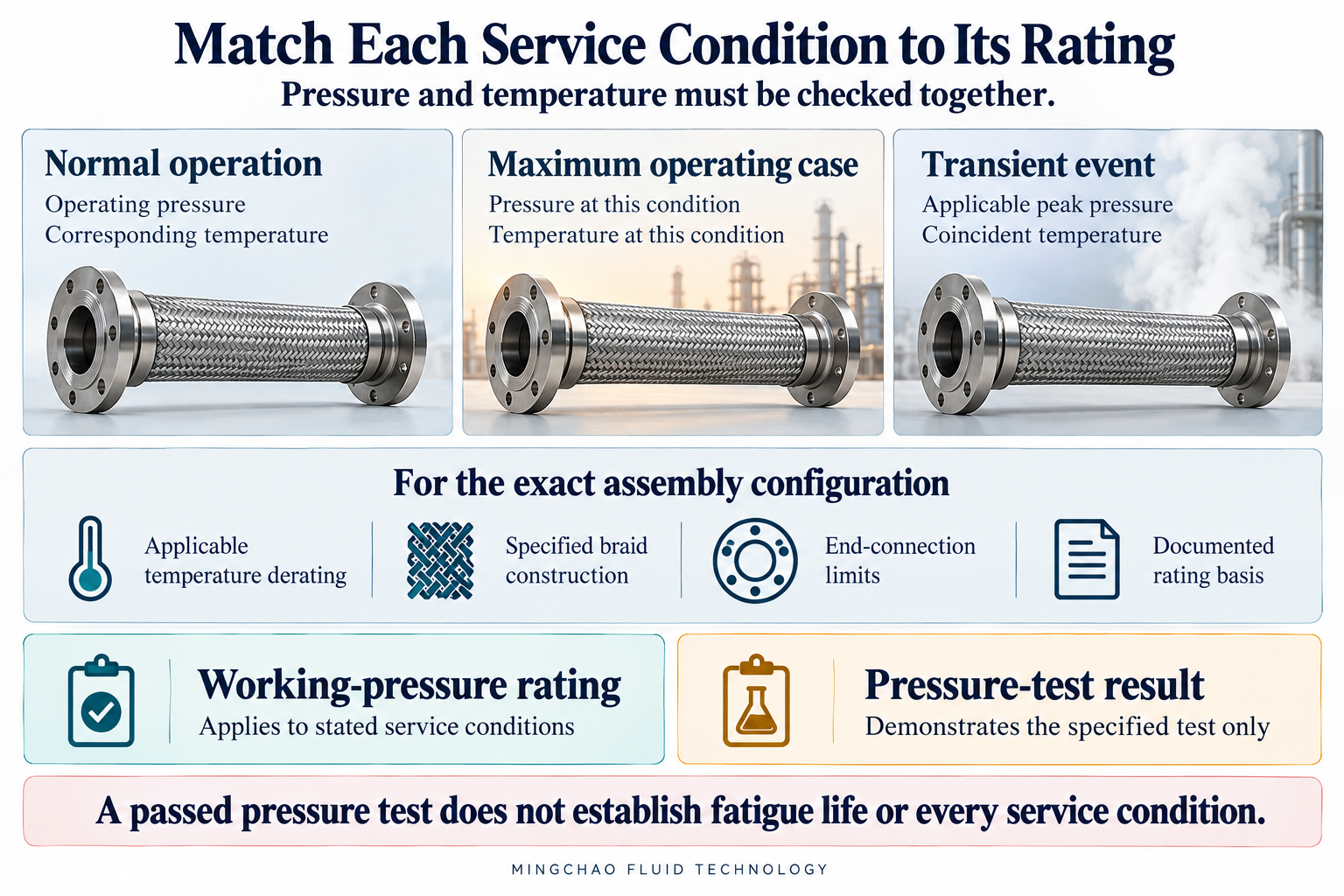
The illustration above shows the review sequence: pair pressure with temperature, check the exact assembly configuration, and distinguish operating capability from a pressure-test result. It contains no numerical product ratings.
6. Compare Quotations on the Same Basis
Use the following review matrix before comparing prices.
| Review item | Information required from each supplier |
|---|---|
| Assembly identity | Size, materials, braid configuration, end fittings and drawing reference |
| Service conditions | Pressure and corresponding temperature for each required case |
| Confirmed capability | Allowable assembly pressure at the specified temperature |
| Temperature adjustment | Applicable source, method and confirmation of whether adjustment is already included |
| Connection limits | End-fitting and attachment suitability for the required conditions |
| Dynamic service | Movement, pressure cycling, vibration and any applicable restrictions |
| Inspection and testing | Agreed procedure, acceptance criteria and traceable records |
| Exceptions | Clear statement of exclusions or conditions requiring further review |
A useful clarification request is:
Please confirm the allowable working pressure of the complete proposed hose assembly at the specified temperature. Identify the hose size and construction, braid configuration, end fittings, drawing reference, rating basis and any restrictions relating to movement or pressure cycling.
A quotation stating only “stainless steel hose, double braid, pressure tested” leaves important questions unanswered.
Pressure Approval Does Not Complete the Selection
An acceptable pressure rating does not establish that the hose has sufficient live length, a suitable bend radius or an appropriate movement arrangement.
Complete the geometry review alongside the pressure review. A straight braided hose should not be compressed or stretched axially to make it fit. For the installation checks, see Stainless Steel Flexible Metal Hose: Live Length, Bend Radius and Installation Movement. Mingchao
For Mingchao’s JR Stainless Steel Flexible Metal Hose, the published pressure and temperature ranges describe the product family. They should not be interpreted as independent maximum values available simultaneously for every configuration. Final allowable pressure requires confirmation for the selected size, braid, temperature, fittings and assembly design. Mingchao
Mingchao can review the proposed configuration against your operating conditions and project drawing. Provide the pressure–temperature schedule together with the medium, movement requirements, installation arrangement and connection details.
Technical References and Related Resources
Mingchao product and project resources
- JR Stainless Steel Flexible Metal Hose
- Live Length, Bend Radius and Installation Movement
- Technical Information & Engineering Resources
External technical references
- Hose Master — Temperature Derating
- Hose Master — Corrugated Metal Hose: Assembly Components and Value
- Hose Master — Metal Hose Definitions
- ISO 10380:2012 — Corrugated Metal Hoses and Hose Assemblies
External references explain engineering principles and terminology. Their product-specific ratings, factors and test results are not Mingchao product ratings.
Mingchao Fluid Technology
www.mingchaoft.com