On this page
- 1. Identify the existing joint
- 2. Confirm the bore and flange connection
- 3. Check the face-to-face length
- 4. Describe the fluid and material requirements
- 5. Provide pressure and temperature together
- 6. Explain movement and restraint requirements
- 7. Agree the replacement specification before ordering
- Replacement enquiry checklist
- Technical references
A photograph and a pipe size are useful starting points for replacing a rubber expansion joint. They are not a complete specification. The replacement must match the connection, fit the available space and suit the actual operating conditions.
Before requesting a quotation, collect the information below. If a detail is unknown, mark it as unknown and ask for a review rather than guessing.
1. Identify the existing joint
Record the manufacturer, model and markings if they are readable. Take an overall photograph and close-ups of the flanges, rubber body and any rods or accessories.
Describe why the joint is being replaced: planned maintenance, leakage, visible damage or a change in service. A replacement enquiry should explain the application as well as identify the old part.
2. Confirm the bore and flange connection
Provide the nominal size, DN or NPS, and the flange standard and pressure designation shown on the drawing or component. If the flange cannot be identified, send a dimensioned drawing or measurements of its outside diameter, bolt-circle diameter, bolt-hole count and hole diameter for review.
Do not approve a replacement simply because its nominal pipe size matches. Confirm the complete connection against the mating pipework.
3. Check the face-to-face length
Provide the specified installation length and the available distance between the mating flange faces. Identify whether each dimension comes from a drawing, an installed joint or a removed component.
Do not assume that an old joint’s measured length is its original free length. Do not pull a new joint into an oversized gap: installation extension can reduce the movement available during operation. Measurements requiring access to pipework should follow the site’s isolation and safety procedures.
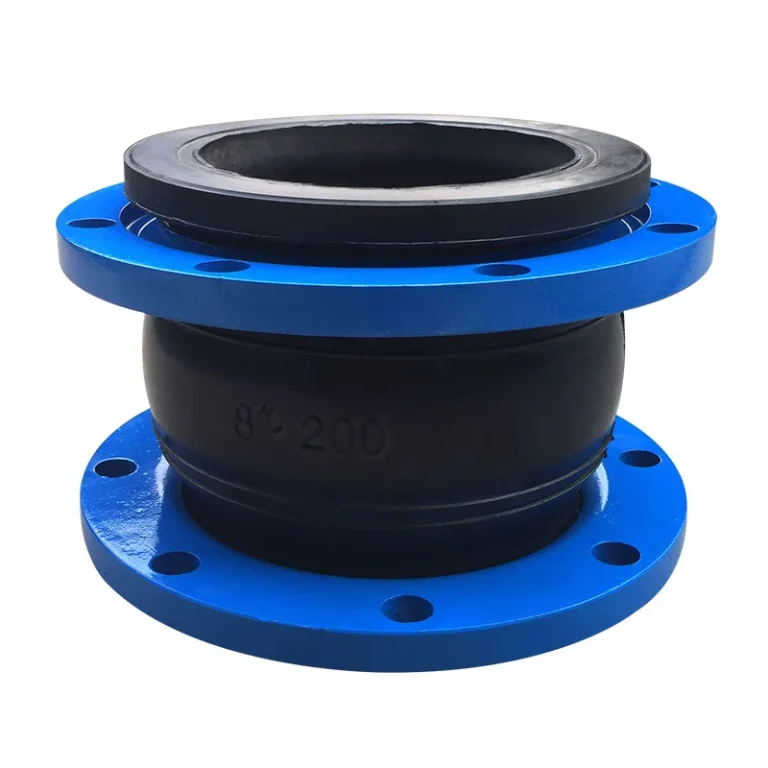
For example, the Mingchao KXT single-sphere rubber expansion joint lists more than one available length for some nominal sizes. Check the relevant configuration rather than selecting by DN alone.
4. Describe the fluid and material requirements
State the actual medium, including concentration or additives where relevant, and any cleaning fluids. Also record the existing elastomer specification if known.
Material names are not interchangeable. EPDM, for example, is used in many water applications but is generally unsuitable for petroleum oils and hydrocarbon fuels. Final selection must consider the particular compound and service conditions. Colour or appearance alone does not establish material suitability.
5. Provide pressure and temperature together
List normal and maximum operating pressure and temperature, along with design conditions and the planned test conditions. Identify any suction or vacuum duty for separate review.
A pressure rating is not independent of temperature. Obtain confirmation for the complete proposed joint at the required conditions; do not transfer ratings from an unrelated product or assume that a flange designation establishes the rating of the whole assembly.
6. Explain movement and restraint requirements
Provide the required axial, lateral and angular movement where known, together with a piping sketch showing supports, anchors, guides and nearby equipment. Identify existing rods or restraints and include their details.
An unrestrained expansion joint transmits pressure thrust to the connected system. The replacement arrangement therefore needs review as part of the piping system, including test conditions. Appearance alone cannot establish whether the existing restraint arrangement is adequate.
7. Agree the replacement specification before ordering
Bring the dimensions and operating conditions together in one enquiry. Resolve missing information and review the proposed drawing, materials and operating limits before approving manufacture.
Include quantity, delivery location and required delivery date separately from the technical specification. A clear enquiry makes it easier to compare quotations for the same requirements.
Replacement enquiry checklist
Use the following checklist when requesting a replacement rubber expansion joint:
- Existing manufacturer/model and reason for replacement:
- DN / NPS:
- Flange standard, designation and dimensional details:
- Installation length and source of the measurement:
- Medium, concentration and cleaning fluids:
- Normal / maximum operating pressure and temperature:
- Design, test and suction / vacuum conditions:
- Required movement and piping / restraint drawing:
- Material or project documentation requirements:
- Quantity, delivery location and required date:
- Attached photographs and drawings:
If information is unavailable, flag the gap for review. Do not fill it with an assumed value.
Mingchao can review your operating conditions and dimensional requirements and propose a configuration for approval. Send your replacement enquiry and drawing.
Technical references
- FlexEJ: identification and replacement FAQs
- FlexEJ: Elaflex rubber bellows installation instructions
- Proco: rubber expansion joint material and operating-condition FAQs
- Mingchao: technical information and project data requirements
References inform the general checks above. Competitor product ratings, certifications and installation torque values are not specifications for Mingchao products. The approved product drawing and applicable instructions govern the supplied assembly.