
On this page
- What Is the Difference Between Single-Sphere and Double-Sphere Designs?
- 1. Start with the Available Installation Length
- 2. Define the Movement the Connection Must Accommodate
- 3. Check Pressure, Temperature and Medium Together
- 4. Review the Piping Support and Restraint Arrangement
- 5. Confirm Flange Compatibility
- When Should Each Configuration Be Considered?
- Information to Provide for Selection
- Frequently Asked Questions
- Is a double-sphere rubber expansion joint always better?
- Can a single-sphere joint be replaced directly with a double-sphere joint?
- Does a double-sphere joint provide twice the movement?
- Which design should be used at a pump connection?
- Selecting a Mingchao Configuration
- Technical References and Related Products
Choosing between a single-sphere and a double-sphere rubber expansion joint requires more than comparing their appearance. The selection should match the available installation space, required movement, operating conditions and piping restraint arrangement.
A single-sphere joint provides a compact flexible connection. A double-sphere joint uses two flexible rubber sections and may offer greater movement capacity in a specified design. However, two spheres do not automatically mean twice the movement, a higher pressure rating or better performance in every installation.
What Is the Difference Between Single-Sphere and Double-Sphere Designs?
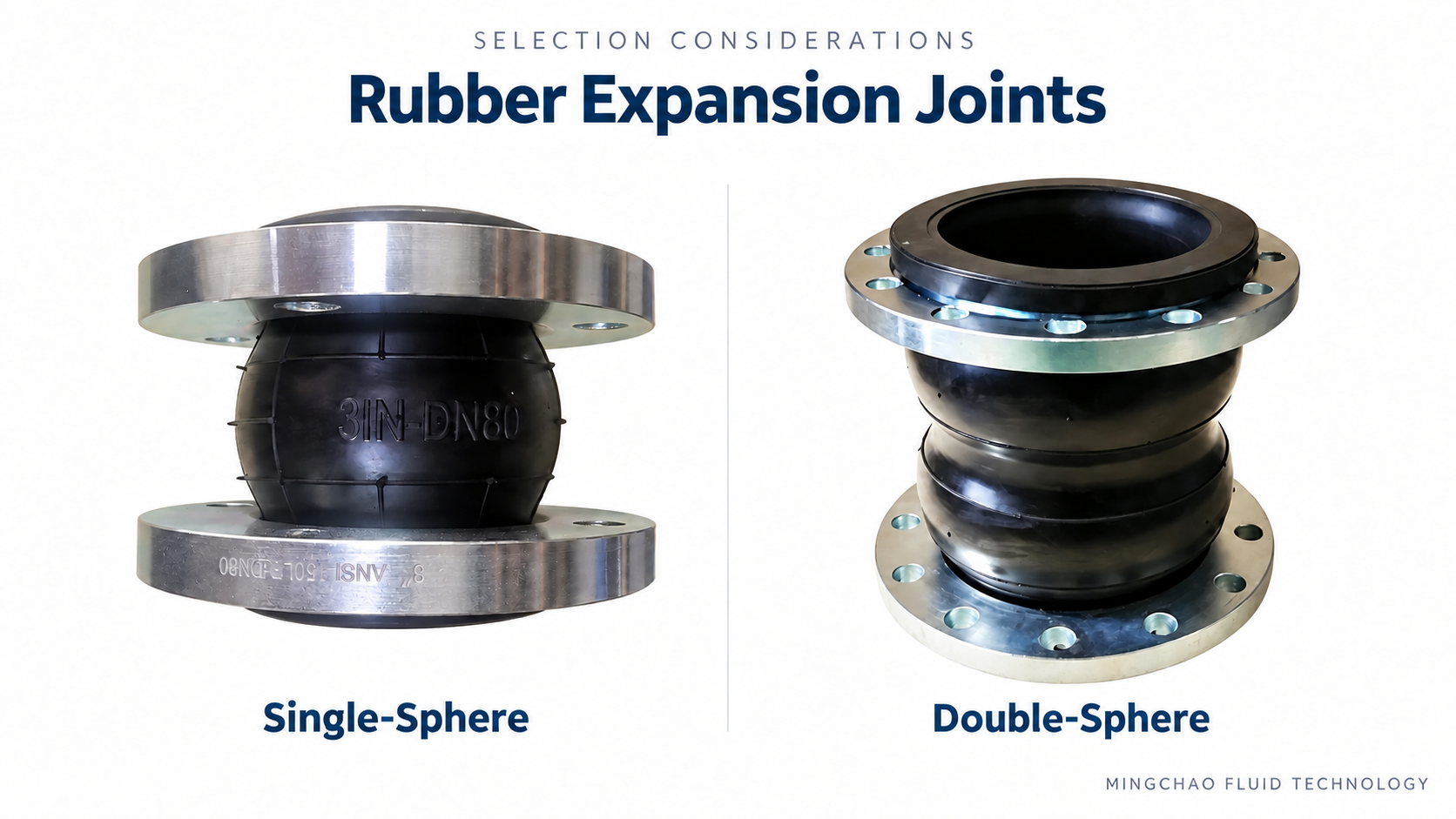
A single-sphere rubber expansion joint has one rounded flexible rubber section between its end connections. A double-sphere rubber expansion joint, also called a twin-sphere rubber expansion joint, has two.
Mingchao’s KXT Single Sphere Rubber Expansion Joint provides a compact connection for piping and equipment. The KST Double Sphere Rubber Expansion Joint offers a different geometry, with greater published movement allowances and generally longer installation lengths across comparable nominal sizes.
The practical question is whether the selected configuration meets the project requirements—not which design has more spheres.
| Selection factor | Single-sphere configuration | Double-sphere configuration |
|---|---|---|
| Rubber body | One flexible spherical section | Two flexible spherical sections |
| Installation space | Often considered for compact connections | Generally requires more face-to-face space |
| Movement | Check the selected model and size | May provide greater movement allowances; verify the selected model |
| Pressure and temperature | Confirm the complete joint rating | Confirm separately; sphere count does not establish the rating |
| Material compatibility | Select for the actual service medium | The same compatibility assessment is required |
| Piping restraint | Review anchors, guides and any control units | Review anchors, guides and any control units |
1. Start with the Available Installation Length
Confirm the distance between the mating flange faces before selecting either design. This face-to-face dimension must match the intended installed length of the joint.
For example, Mingchao’s published DN100 data lists several KXT lengths, including 130, 135 and 150 mm, while the published KST length is 225 mm. These dimensions illustrate why the same nominal diameter does not make the two configurations interchangeable. Check the applicable KXT datasheet and KST datasheet against the project drawing.
Do not choose a longer joint and compress it simply to fit an existing gap. Any intentional preset must be specified in an approved installation arrangement.
For a replacement, record both the available pipework gap and the original specified joint length. A used joint may be deformed, so its measured length alone may not represent the correct replacement dimension.
2. Define the Movement the Connection Must Accommodate
Describe movement by direction rather than requesting a joint with “more flexibility.”
- Axial extension: an increase in the distance between the connected ends.
- Axial compression: a decrease in that distance.
- Lateral movement: sideways displacement between the ends.
- Angular movement: a change in the angle between the connected ends.
Provide the expected movement in each direction and identify whether movements occur together. Ask the manufacturer to confirm the permissible combination rather than assuming that every separately listed maximum can be used simultaneously.
The KST datasheet publishes movement values by nominal size. Use the relevant row and obtain confirmation for the proposed operating conditions. Do not derive an allowance by multiplying single-sphere figures by two.
3. Check Pressure, Temperature and Medium Together
Neither shape alone establishes suitability for the service.
The selection review should identify normal operating pressure, maximum design pressure, operating temperature and any vacuum conditions. Include startup, shutdown or other transient conditions that differ from normal operation.
Rubber compatibility also depends on the actual fluid and temperature. For chemical service, provide the substance, concentration and any cleaning fluids. A description such as “water service” or “oil service” may not contain enough information for material selection.
A double-sphere geometry does not compensate for an unsuitable rubber compound. Likewise, a flange pressure designation should not be treated as the working-pressure rating of the complete rubber expansion joint.
4. Review the Piping Support and Restraint Arrangement
An expansion joint is part of a piping system. Its suitability depends on the surrounding installation as well as its own dimensions.
Before ordering, identify the nearby supports, anchors and guides, and whether the proposed assembly includes control or restraint components. Ask for confirmation of the intended movement and restraint arrangement on the project drawing.
Do not use either configuration to carry unsupported pipe weight or pull misaligned pipework into position. Fit the joint without twisting or forced extension or compression unless an approved drawing specifies otherwise. These requirements also appear in Mingchao’s Rubber Expansion Joint Installation Guide.
If the existing joint has stretched, distorted or repeatedly leaked, investigate the installation conditions before selecting a replacement with a different shape.
5. Confirm Flange Compatibility
Matching DN or NPS is only the starting point.
Check the mating flange standard, pressure designation, bolt-hole quantity, hole diameter, bolt-circle diameter and sealing-face arrangement. Include these details in a drawing where possible.
Keep flange compatibility and joint performance as separate checks. A joint may fit the bolt pattern but still have an unsuitable installation length, material or operating rating.
When Should Each Configuration Be Considered?
Consider a single-sphere rubber expansion joint when the available space suits a compact connection and the selected model meets the required movement and service conditions.
Consider a double-sphere rubber expansion joint when its documented movement capability better matches the application and sufficient installation space is available.
If both meet the technical requirements, compare the complete proposed assemblies, including their dimensions, materials, restraint requirements and maintenance access. Selecting additional movement capacity that the system does not need should not take priority over correct fit and verified suitability.
Information to Provide for Selection
For an effective technical review, prepare:
- DN or NPS and required quantity.
- Mating flange standard and dimensions.
- Available face-to-face length.
- Operating and design pressure, including any vacuum conditions.
- Normal and maximum temperature.
- Fluid composition and concentration, where applicable.
- Required axial, lateral and angular movement.
- Details of nearby supports, anchors, guides and restraint components.
- An installation drawing and photographs of the connection.
Identify unknown information clearly so it can be resolved during review.
Frequently Asked Questions
Is a double-sphere rubber expansion joint always better?
No. Its movement capability may be useful for a particular application, but the joint must also fit the available space and satisfy the service and installation requirements.
Can a single-sphere joint be replaced directly with a double-sphere joint?
Not on nominal diameter alone. Confirm face-to-face length, flange dimensions, movement requirements, operating suitability and the surrounding piping arrangement before changing configurations.
Does a double-sphere joint provide twice the movement?
There is no universal two-to-one rule. Use the published data for the selected model and size, followed by project-specific confirmation.
Which design should be used at a pump connection?
Either may be considered when its documented capabilities suit the application. Review available space, service conditions, movement and the piping arrangement instead of selecting by sphere count alone.
Selecting a Mingchao Configuration
Mingchao Fluid Technology can review your operating conditions, connection dimensions and installation requirements to propose an appropriate single-sphere or double-sphere configuration. Final dimensions and performance requirements should be confirmed against the approved project documentation.
Technical References and Related Products
- Single-sphere: KXT Single Sphere Rubber Expansion Joint · Technical Datasheet — PDF
- Double-sphere: KST Double Sphere Rubber Expansion Joint · Technical Datasheet — PDF
- Project preparation: Technical Information & Project Requirements
- Related reading: Technical Requirements for Rubber Expansion Joint Replacement: Seven Key Checks