
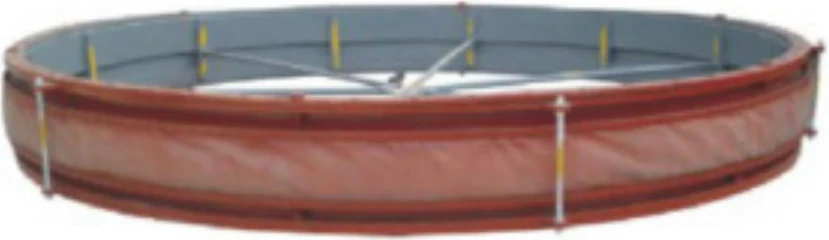
Air Duct & Fabric Expansion Joints
Round Fabric Expansion Joint for Air Ducts
Mingchao’s round fabric expansion joint is a non-metallic flexible connection for circular industrial ducting. It accommodates project-defined thermal movement, vibration and installation offset while the fabric system, frame, pressure/vacuum capability and temperature resistance are selected for the actual air or gas service. The Mingchao catalog provides circular connection dimensions from Ø108 to Ø3620 mm.
Round / Circular Fabric Expansion Joint — Fabric Expansion Joint for Circular Industrial Ducting
- Product Type
- Round Fabric Expansion Joint
- Duct Geometry
- Circular / Round
- Catalog Size Range
- Ø108–Ø3620 mm
- Flexible Element
- Fabric / Non-Metallic
- Typical Service
- Air & Industrial Gas Ducting
- Movement
- Project-Specific
- Pressure / Vacuum
- Project-Specific
- Temperature / Material
- Project-Specific
Project Configuration
Mingchao can customize the product configuration based on the technical information, operating conditions and dimensional data you provide. Final configuration can be reviewed and manufactured to the approved project drawing.
Round Fabric Expansion Joint for Air Ducts — Overview
Mingchao’s round fabric expansion joint is intended for circular duct systems that need a flexible connection between rigid duct sections or between ductwork and equipment. The flexible element is non-metallic, while the circular connection geometry interfaces with the surrounding metal duct or frame.
Unlike a pressure-piping rubber joint or a metal bellows expansion joint, a fabric duct joint is selected from the duct geometry and the actual gas-service conditions. Temperature, pressure or vacuum, movement, gas chemistry, moisture, dust loading, abrasion and flow conditions all influence the required fabric construction and any liner or insulation arrangement.
The current Mingchao catalog provides circular connection dimensions from Ø108 to Ø3620 mm. Service ratings are not treated as universal values on this page because the flexible-element construction must be confirmed for the project.
Why Circular Duct Systems Use Fabric Expansion Joints
Round ducts are common around fans, blowers, process-air systems, dust collection and many industrial gas-handling systems. A round fabric expansion joint provides a compliant section without changing the basic circular flow path.
The joint can be supplied as a fabric element integrated with or attached to circular connection hardware. The exact flange, frame, clamping and liner arrangement depends on the project drawing and service conditions.
Round geometry is a real product distinction from the rectangular fabric expansion joint used on rectangular ductwork; buyers should specify the actual duct diameter and connection dimensions rather than treating the two shapes as interchangeable.
Flexible Fabric Element, Frame & Circular Connection Geometry
A typical fabric expansion-joint assembly combines a flexible non-metallic element with metal connection or clamping hardware. Depending on the service, engineered assemblies may also use back-up bars, frames, an internal liner or baffle, and an insulation or cavity pillow.
These features are not universal round fabric expansion joint components. Mingchao should confirm the required construction after reviewing the operating temperature, gas composition, dust or particulate content, pressure or vacuum, movement and flow conditions.
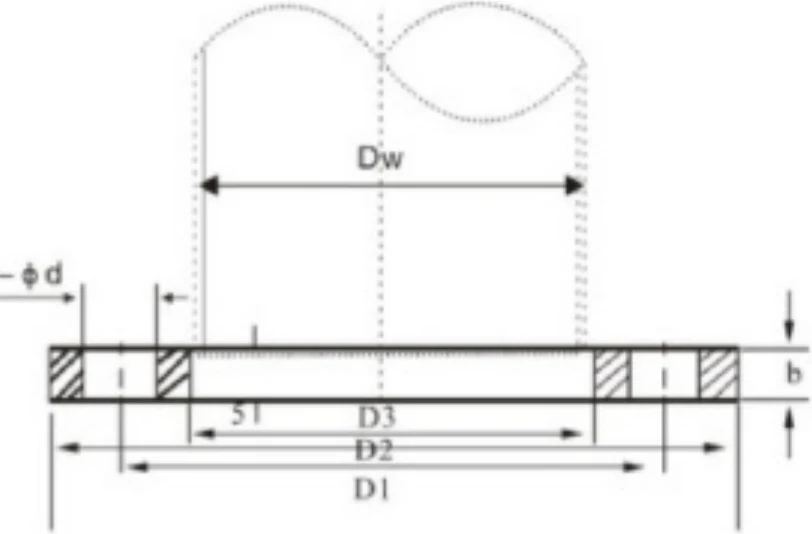
The Mingchao p33 drawing is the source-confirmed reference for the circular connection geometry. Exact fabric layers and metal grades remain project-specific until documented.
Movement, Fan Vibration & Duct Misalignment
Fabric expansion joints are selected to accommodate designed movement with low reaction force in duct systems. The flexible element can also reduce direct transmission of fan or blower vibration and tolerate limited installation offset when the joint is engineered for those conditions.
Do not use the joint to force misaligned ductwork into position. Required axial, lateral and angular movement should be stated separately in the RFQ. Mingchao should confirm the final movement envelope for the selected fabric construction and installed gap.
Torsion, pressure pulsation and high-velocity flutter should be treated as engineering-review items rather than assumed operating capabilities.
Technical Data — Circular Connection Dimensions
The table provides published circular connection dimensions for preliminary selection. All dimensions are in millimetres.
| Circular Product Specification | DW (mm) | D1 (mm) | D2 (mm) | D3 (mm) | Bolt-Hole Diameter φd (mm) |
|---|---|---|---|---|---|
| φ108 | 108 | 200 | 164 | 110 | 10 |
| φ159 | 159 | 251 | 215 | 161 | 10 |
| φ219 | 219 | 311 | 275 | 211 | 10 |
| φ273 | 273 | 365 | 330 | 275 | 10 |
| φ325 | 325 | 427 | 385 | 327 | 10 |
| φ377 | 377 | 479 | 435 | 379 | 12 |
| φ426 | 426 | 528 | 490 | 428 | 12 |
| φ480 | 480 | 595 | 540 | 483 | 12 |
| φ530 | 530 | 645 | 600 | 533 | 12 |
| φ630 | 630 | 745 | 700 | 633 | 12 |
| φ720 | 720 | 843 | 800 | 723 | 12 |
| φ820 | 820 | 943 | 900 | 823 | 14 |
| φ920 | 920 | 1043 | 1000 | 923 | 14 |
| φ1020 | 1020 | 1153 | 1100 | 1023 | 14 |
| φ1120 | 1120 | 1253 | 1200 | 1123 | 14 |
| φ1220 | 1220 | 1353 | 1300 | 1223 | 14 |
| φ1320 | 1320 | 1453 | 1400 | 1323 | 14 |
| φ1420 | 1420 | 1553 | 1500 | 1423 | 14 |
| φ1820 | 1820 | 1963 | 1910 | 1823 | 16 |
| φ2020 | 2020 | 2363 | 2310 | 2223 | 16 |
| φ2220 | 2220 | 2363 | 2310 | 2223 | 16 |
| φ2420 | 2420 | 2563 | 2510 | 2423 | 16 |
| φ2820 | 2820 | 2983 | 2915 | 2823 | 18 |
| φ3220 | 3220 | 3883 | 3315 | 3223 | 18 |
| φ3620 | 3620 | 3783 | 3715 | 3623 | 18 |
Several legacy source relationships are non-monotonic, and the grouped b and n columns are not published in this revision because their row grouping requires separate confirmation. Final manufacturing dimensions should be confirmed against the approved project drawing.
Material System Selection for Air, Gas, Dust & Temperature
The flexible element for a fabric expansion joint is selected as a system rather than by one universal fabric name. The required construction depends on operating temperature, gas chemistry, moisture or condensation, dust and abrasion, pressure or vacuum, movement and exposure conditions.
Depending on the project, a fabric system may use one or more functional layers for sealing, mechanical reinforcement, thermal protection or insulation. The exact materials and layer sequence must be confirmed by Mingchao for the actual service.
Do not assume PTFE, silicone-coated glass fabric, EPDM, FKM, ceramic fibre or any other specific material is standard for every round fabric expansion joint unless the quotation or factory documentation states it.
When a Liner, Baffle or Insulation Pillow May Be Required
An internal liner or baffle may be useful where the flexible element needs protection from direct gas flow, high velocity, turbulence or abrasive solids. An insulation or cavity pillow may be required where the service temperature or particulate environment demands additional thermal or cavity protection.
These items are optional engineering features, not universal round fabric expansion joint construction. Their need should be determined from gas velocity, temperature, particulate loading, flow direction, movement and the available installation geometry.
Applications in Fans, Flue-Gas & Industrial Ducting
Typical project contexts include fan and blower connections, process-air ducts, flue-gas ducts, dust-collection systems, boiler and furnace ducting, power-generation air and gas systems, cement and mineral-processing ducts, pollution-control equipment and other circular industrial ductwork.
These are application contexts, not blanket service approvals. Gas chemistry, temperature, pressure or vacuum, dust, abrasion and moisture must be reviewed before final material selection.
How to Specify a Round Fabric Expansion Joint
Start with the circular duct diameter and the required movement. Then define the available installed gap or face-to-face length, connection dimensions and whether the joint will connect duct-to-duct or duct-to-equipment.
Next provide the operating and design temperature, positive or negative pressure, gas composition, moisture or condensation, dust loading, abrasion, gas velocity and any pressure pulsation or fan-induced vibration.
Finally define material requirements, liner or baffle, insulation, frame or clamping details, bolt pattern, installation orientation, inspection or documentation requirements and the project drawing. These inputs allow Mingchao to select the fabric system and assembly rather than applying a generic rating.
For accurate selection, send the round duct diameter, required movement, installed gap, temperature, pressure or vacuum, gas composition, dust or abrasion conditions, connection dimensions and a project drawing where available.
- Circular duct diameter
- Required axial movement
- Required lateral movement
- Required angular movement
- Installed gap / face-to-face length
- Duct-to-duct or duct-to-equipment
- Fan / blower / equipment location
- Connection / flange dimensions
- Bolt-hole pattern / drilling
- Operating temperature
- Design / upset temperature
- Operating pressure
- Design pressure
- Vacuum / negative-pressure condition
- Air / gas / medium
- Gas composition
- Corrosive constituents
- Moisture / condensation
- Dust / particulate loading
- Abrasion condition
- Gas velocity
- Pressure pulsation if applicable
- Fan-induced vibration
- Fabric / material requirement if specified
- Internal liner / baffle requirement
- Insulation / cavity pillow requirement
- Frame / connection material if specified
- Installation orientation
- Support arrangement
- Quantity
- Destination
- Testing / inspection / documentation
- Project drawing / duct layout
Round Fabric vs. Rubber Duct Expansion Joint
round fabric expansion joint is a round fabric expansion joint for industrial ducting. FUB/FVB rubber duct expansion joint is a rubber duct expansion-joint family. Both can provide flexible duct connections, but they are not interchangeable product identities.
The correct choice depends on temperature, gas chemistry, pressure or vacuum, movement, vibration, duct geometry and the required flexible-element construction. Where a rubber element is preferred and the operating envelope is suitable, use the FUB/FVB rubber duct expansion joint rubber duct family. Where a fabric or multilayer non-metallic system is required, select round fabric expansion joint or the corresponding rectangular fabric configuration.
Round vs. Rectangular Fabric Expansion Joint
The main distinction is duct geometry. round fabric expansion joint is intended for circular or round duct connections; rectangular fabric expansion joint is the separate rectangular fabric expansion-joint product for rectangular ductwork.
Do not apply the round fabric expansion joint circular table to a rectangular project. For rectangular ducts, width, height, corner geometry and frame dimensions must be taken from the rectangular configuration and project drawing.
Installation, Clamping & Welding Protection
Install the joint only after the adjoining ductwork and equipment are aligned and independently supported. Do not use the flexible element to pull rigid duct sections into position.
Tighten flange, clamp or back-up hardware progressively and evenly so the flexible element is not locally pinched or wrinkled. Where spring washers, limit or adjustment hardware are part of the approved connection, keep them in the specified position.
Protect the fabric surface from sharp edges, impact, welding sparks, hot slag and construction debris. When nearby welding is unavoidable, cover the flexible element and prevent heat or spatter from damaging it.
Do not over-stretch, twist or preset the joint unless the approved project drawing explicitly requires it. Before commissioning, check the installed gap, connection security, liner clearance if fitted, and freedom to move in the intended directions.
Product Photo, Drawing & Project RFQ
Final production should be based on the approved duct diameter, connection geometry, movement requirement, operating conditions and project drawing.
JB/T 12235-2015 is the current Chinese industry-standard reference for non-metallic compensators. A revision project (2024-1831T-JB) is underway. Project-specific compliance and documentation should be confirmed during quotation.
Technical Datasheet
Round Fabric Expansion Joint for Air Ducts
Technical Datasheet · PDF